Yoga Nidra
The practice of conscious rest
The practice of conscious rest
Yoga nidra is a guided practice of conscious rest — a structured descent into the threshold between waking and sleeping. In this liminal state, the body restores, the nervous system quiets, and awareness opens into something wider than ordinary attention allows.
The practice is ancient. It draws from South Asian yogic traditions and resonates with indigenous sleep and dream-threshold practices found across cultures worldwide. It is not a modern invention. It is not a relaxation technique borrowed by wellness culture and repackaged. It is a threshold state that has been honored across traditions for thousands of years — a place between waking and sleeping where the body remembers what the mind has been too busy to hear.
In practice, yoga nidra is deceptively simple. You lie down. You listen. A guide moves your awareness through the body, through breath, through sensation, through layers of experience that most of us never access in ordinary waking life. You stay conscious but deeply relaxed. There is nothing to do, nothing to perform, nothing to achieve. The practice meets you exactly where you are.
You don't need any yoga experience. You don't need to be flexible, spiritual, or quiet. You need only a willingness to lie down and listen.
"Rest is not a productivity hack. It is a genuine reclamation of the body's right to rest — deeply, unapologetically, as a foundation for everything else."
We live in a culture that has pathologized rest. Stillness is framed as laziness. Lying down in the middle of the day is treated as indulgence rather than necessity. The exhaustion most people carry is not personal failure — it is systemic. The imperative to produce, perform, and optimize has severed our connection to the body's natural rhythms of restoration.
Yoga nidra is a corrective. Not a tool for "better sleep so you can work harder." A genuine return to a state the body already knows — the threshold between waking and sleeping where deep restoration happens without effort, without performance, without needing to prove that you deserve it.
And when that rest happens on shared ground — when you lie down next to others who are also choosing to stop — something shifts. Rest becomes communal. Permission becomes collective. You don't have to perform your relaxation for anyone. You simply lie down next to others who are also lying down, and the collective permission to stop is itself a form of care.
Rest is not the reward you earn after breaking down. It is the ground from which resilience grows.
Wild Nidra is yoga nidra practiced in direct relationship with the living landscape — on the ground, under open sky, inside the sensory field of a specific place at a specific moment.
The term comes from Uma Dinsmore-Tuli, co-founder of the Yoga Nidra Network and author of Nidra Shakti: The Power of Rest. Dinsmore-Tuli developed Wild Nidra as part of a broader effort to recover yoga nidra from the institutional frameworks that have commodified and narrowed it — returning the practice to its intuitive, embodied, and ecological roots.
Where conventional yoga nidra is typically facilitated in studios — controlled lighting, curated soundscapes, climate-managed rooms — Wild Nidra refuses that separation. The practice happens in the world. Birdsong replaces playlists. Wind becomes a breath cue. The temperature dropping as the sun sets is not a disruption to manage but an invitation to attune. The ground beneath you is not a metaphor for grounding — it is the ground itself, with its own geology, its own memory, its own rhythm.
The threshold state that yoga nidra opens — that liminal space where deep rest and insight become possible — mirrors the thresholds that exist in the natural world: the turning of a tide, the transition from day to night, the shift between seasons. When we practice nidra inside those ecological thresholds, the inner and outer landscapes begin to resonate. The practice deepens not through effort but through alignment.
Every community has places that hold more than their geography suggests. A cove where the tide reveals ancient granite. A hillside where the light behaves differently in August than it does in June. A clearing in the woods where sound travels strangely and the canopy filters the sky into something cathedral-like.
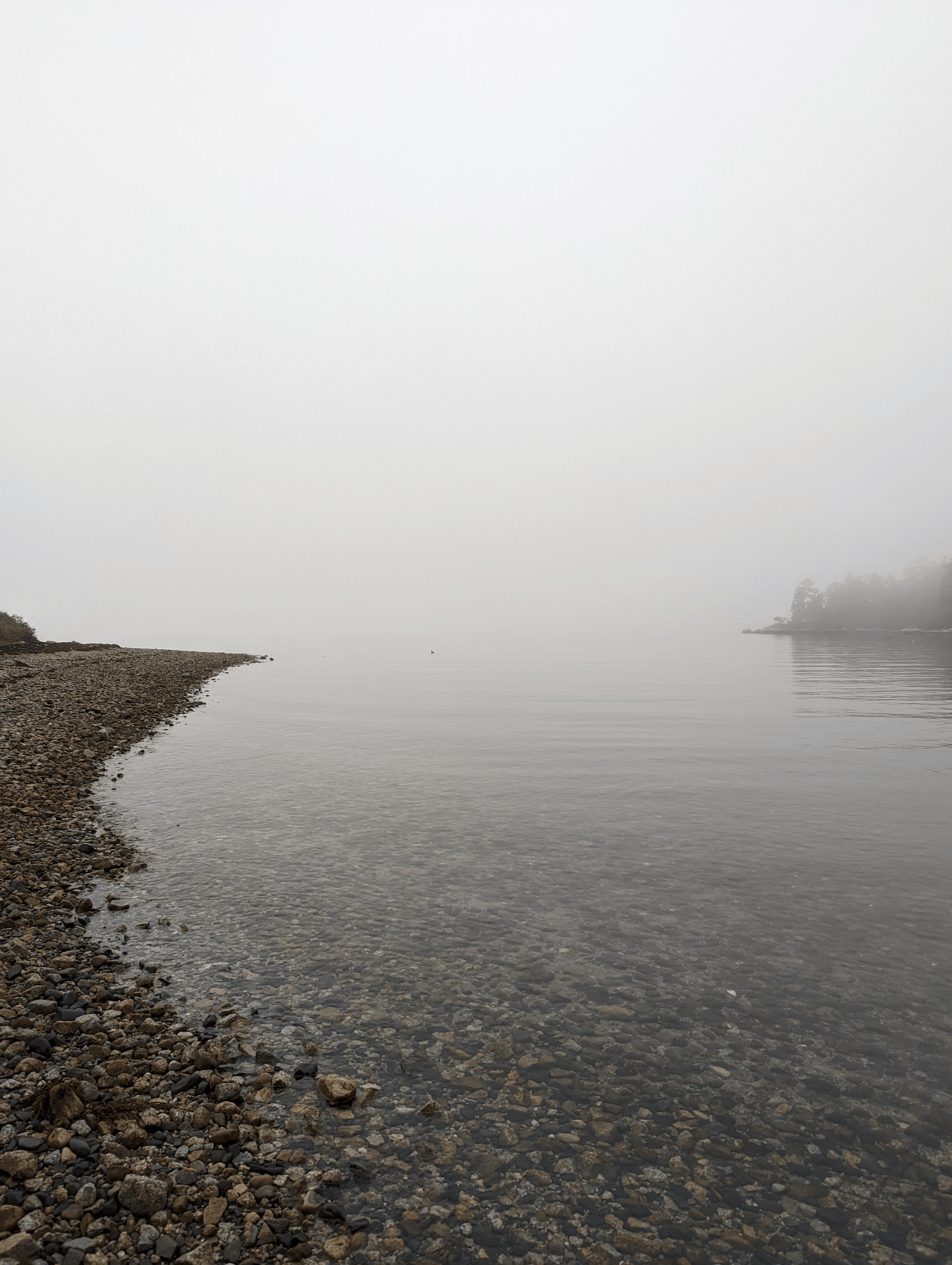
These are not interchangeable backdrops. They are participants in the practice. When we bring yoga nidra to a place like Curtis Cove — where the Mt. Desert Narrows pull back over rock shaped across five hundred million years of geological history, where the tidal rhythm has been teaching withdrawal and return long before any human lay down to rest — we are not just "doing yoga outside." We are entering into relationship with a place.
Wild Nidra within our most treasured local spaces offers something a studio cannot: the chance to know a place the way the body knows it. Not through interpretation or signage or historical narrative, but through the felt experience of lying on it, breathing with it, falling into the threshold state while it holds you. Over time, this practice changes how you move through these spaces when you're awake, too. The relationship deepens. The place becomes yours — not as property, but as kinship.
These coastal landscapes, these tidal zones, these places where land and water negotiate their boundary twice a day — they have always been threshold spaces. Long before we arrived with our mats and blankets, the earth was already practicing its own nidra: the daily rhythm of exposure and concealment, the seasonal pulse of growth and dormancy, the geological patience of stone shaped by ice and salt across millennia. Wild Nidra is simply our way of joining that rhythm. Of remembering that we are not separate from it.
The language and framework of Wild Nidra draw from the work of Uma Dinsmore-Tuli, co-founder of the Yoga Nidra Network. Her encyclopaedia Nidra Shakti: The Power of Rest honors the South Asian yogic heritage of the practice while revealing its connections to indigenous sleep and dream-threshold traditions found across cultures worldwide. This offering exists in deep gratitude for her scholarship and advocacy.
Join a seasonal Wild Nidra session or book a private practice tailored to you.
Upcoming Events Book a Session